

Tuesday April 14, 2026 6:47 pm
Tuesday April 14, 2026 6:47 pm
ECONOMYNEXT – The International Monetary Fund has warned of a global recession risk if the war on Iran continues, at its 2026 Spring Meetings held at the IMF and World Bank in Washington, DC.
“War in the Middle East darkened the global outlook. Energy disruptions imply higher inflation and weaker economic growth, by how much depends on the conflict’s duration and scale.”
Global growth is projected to slow to 3.1 percent in 2026.
Inflation is set to rise to 4.4 percent before easing to 3.7 percent in 2027 — a 0.6 percentage point upward revision relative to January, driven by higher commodity prices.
The IMF cut West Asia and North Africa growth cut to 1.1 percent. Its China forecast was cut to 4.4 percent.
The global lender forecast an 0.8 percent growth for the UK. Eurozone economic growth will slow to 1.1 percent, it said.
Central banks don’t need to raise interest rates right away, IMF Chief Economist Pierre-Olivier Gourinchas said, but watch for signs.
“This is a negative supply shock, and no central bank can influence global energy prices on its own. Markets are already pricing in higher policy rates. However, provided inflation expectations remain well anchored, central banks can afford to wait and watch for now, but they must be attentive to risks and communicate clearly the readiness to act the decisively to maintain price stability. In most cases, exchange rates should be allowed to adjust, allowing central banks to focus on their mandates.”
The IMF warned of increasing job losses, and global hunger to rise.
The IMF painted a dire picture, and did something they haven’t done before, by coming up with not one forecast, but three forecasts.
The full text of Pierre-Olivier Gourinchas speech at the IMF press briefing is reproduced below:
Good morning, everyone. So, despite the major trade disruptions and policy uncertainty, last year ended on an upbeat note. The private sector adapted to a changing business environment, helped by lower than announced US tariffs, fiscal support in some countries, favorable financial conditions, and a tech boom.
Despite downside risks, this momentum was expected to carry into 2026, and we were looking to lift up our global growth forecast. Now war in the Middle East has halted this momentum.
The closing of the Strait of Hormuz and serious damage to critical energy facilities in the Middle East raised the prospect of a major energy crisis should a durable solution not be found soon.
Oil and gas prices have increased sharply and so have the prices of diesel and jet fuel, fertilizer, aluminum, and helium.
The overall impact will depend on three channels: First, higher commodity prices or textbook negative supply shock, rising prices and costs disrupting supply chains, and eroding purchasing power.
Second, these effects may be amplified as firms and workers try to recoup losses, risking wage price spirals, especially where inflation expectations are poorly anchored.
Third financial conditions could tighten with lower asset valuations, higher risk premium, capital flight, dollar appreciation, dampening demand.
Our report presents three scenarios.
Our reference forecast assumes a short-lived conflict and a moderate 19 percent rise in energy prices in 2026. Still, some damage will not be avoided. Global growth falls to 3.1 this year, downgraded from January forecast; and headline inflation rises to 4.4 percent.
Our adverse scenario assumes further disruption, leading to higher energy prices and inflation expectations and tighter financial conditions throughout the year. Growth falls to 2.5 percent this year, and inflation rises to 5.4 percent.
Our severe scenario assumes that energy supply disruptions extends into next year with greater macro instability. Global growth falls to 2 percent this year and next, while inflation exceeds 6 percent. Downside risks are clearly very elevated.
Now, the impact of the war will be uneven. Low-income energy importers are highly exposed, especially those with pre-existing vulnerabilities and limited buffers. But the damage is most severe for countries in the Gulf.
Today’s shock equals the 2022 Commodity Price Surge; Then central banks delivered a successful disinflation without a recession. Can we expect the same outcome now? There are reasons to doubt it.
In 2022, inflation pressures were already elevated by post-pandemic support policies. Today, underlying demand pressures have eased so inflation remains above target in some countries, notably the United States.
If the shock remains modest, inflation may be more contained, consistent with our reference scenario.
Still, the last episode left scars. Higher prices raised cost of living concerns and made inflation expectations potentially more sensitive to new price increases. And the 2022 surge reflected an unusually steep aggregate supply curve from supply bottlenecks, Enabling disinflation with limited output losses. Our analysis shows the supply curve is now much flatter, making any central bank engineered disinflation more costly in terms of unemployment.
So, what should policy makers do?
Let’s start with central banks. This is a negative supply shock, and no central bank can influence global energy prices on its own. Markets are already pricing in higher policy rates.
However, provided inflation expectations remain well anchored, central banks can afford to wait and watch for now, but they must be attentive to risks and communicate clearly the readiness to act the decisively to maintain price stability. In most cases, exchange rates should be allowed to adjust, allowing central banks to focus on their mandates.
What should fiscal policy do?
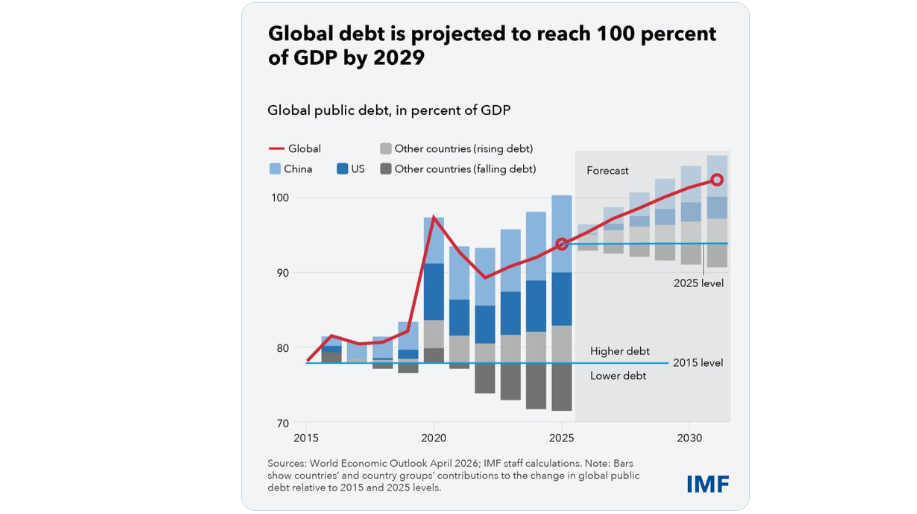
With rising public debt trajectory, fiscal space is much thinner than before. Price caps, subsidies, and similar interventions are popular, but they distort prices. They’re often poorly designed, hard to unwind and extremely costly. Most countries don’t have that luxury anymore.
While support for the most vulnerable is needed, targeted and temporary measures should be deployed, consistent with medium-term plants to rebuild fiscal buffers and avoiding stimulating demand where inflation is rising.
Finally, if financial conditions tightened sharply, as in our severe scenario, and global activity deteriorates markedly, monetary and fiscal policy should be ready to pivot to support the economy and safeguard the financial system, alongside appropriate financial and liquidity policies.
Now, the war demands immediate attention, yet it should not derail from the pursuit of durable growth. It should also spur faster adoption of renewable energy, which can strengthen resilience to energy shocks, improve energy security, and support the climate transition.
Advances in artificial intelligence promised large productivity gains lifting living standards, but the transition may be bumpy. Markets may well be ahead of fundamentals. New jobs will emerge, but some existing ones will also disappear. Policy makers should promote adoption while easing the labor market transition.
The world economy faces another difficult test, fraying alliances, new conflicts, and waves of inward-looking policies, such as trade restrictions, undermine cooperation and growth, Growing strains on international order are pushing toward a multi-polar world; But a more multiple world need not be a more fragmented one.
In fact, countries are finding new trade partners and forming trade agreements beyond traditional geopolitical lines.
We should keep strengthening local cooperation. With the right policies, including a swift cessation of hostilities and reopening of the Strait of Hormuz, the damage can remain limited. Thank you. (Colombo/Apr14/2026)
Continue Reading







Leave a Reply