


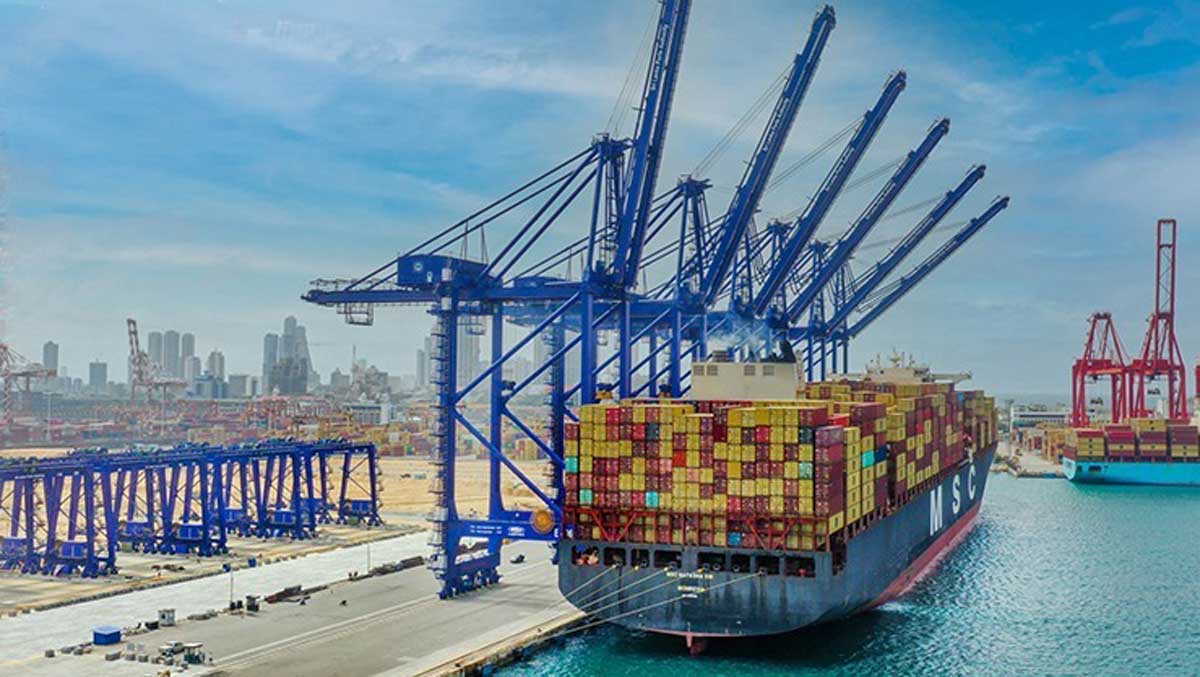
ECONOMYNEXT – Adani Ports-controlled Colombo West International Terminal (CWIT) is a vision of the future. Its quayside cranes that move containers between ships and trucks and yard cranes, which stack them up six high temporarily, are operated remotely from its main building. Data from crane-mounted cameras and sensors are used by teams, including young women not normally known to be employed as longshoremen, to manoeuvre containers between ships, trucks and yards using joysticks.
Indian Adani Port’s CWIT unit is growing at a record pace, handling 1 million twenty-foot containers (TEUs) in just a year since commencing and with just eight quayside cranes, as civil works to complete the terminal continue.
At full capacity, Colombo’s newest and most technologically advanced port terminal expects to employ 250 people, up from 172 now. “We can then handle 3.5 million containers a year,” says Iresh Siriwardena, CWIT’s chief operating officer.
With two other private sector-built and operated container terminals, SAGT and Chinese-owned CICT, and three state-owned ones, Jaya, East Container Terminal, and Unity, Colombo handled 8.2 million containers in 2025, making it a global top 25 seaport by volume (Chart 1).
Record Container Volume
Number of twenty-foot equivalent containers handled (TEU, Mn)
It’s long been contended by the state that Sri Lanka’s maritime industry punches above its weight. Colombo port handles 0.8% of global container traffic, while Sri Lanka’s share of global trade is less than a tenth of that, at 0.05%. Major hub seaports to the east and west of Sri Lanka; Dubai at (2.3%) and Singapore at (4.5%) handle a much larger share of containers (Chart 2).
Sri Lanka is no manufacturing superpower, but it is a major hub for transshipment.
Punching above its weight
Share of global container traffic and trade
Shifting economic geography
During the 1980s and 1990s, container seaport rankings were dominated by the likes of Singapore, Hong Kong, Rotterdam, and Kobe. It was only in 1996 that Colombo port’s container terminal, at the time, the state-controlled Jaya Container Terminal or JCT, achieved the 1 million TEU milestone. Japan funded JCT’s first phase, which was completed in 1985.
China became the world’s factory during the 1990s, and the export success of East Asian Tiger economies led to growth at ports like Singapore and Southeast Asian ones like those in Malaysia. The UN Trade and Development Organisation ranked Sri Lanka 20th globally for shipping connectivity in 2025, a location advantage that enabled Colombo’s rise since the mid 1990s. Of the 8.2 million containers handled in 2025, 81% or 6.6 million boxes were transshipment or cargo that one ship drops off for another to pick up.
This map of global commerce has shifted once again. Asian supply chains are shifting away from China to new locations, including in Southeast Asia and South Asia. For Sri Lanka, the rise in Indian freight is significant. Already, Indian containers are 45% of the cargo transhipped through Colombo.
Romesh David, former CEO of South Asia Gateway Terminals (SAGT), one of six terminals at Colombo, suggests Sri Lanka is underestimating the scale of the Indian opportunity. He recalls a comment made by Krishan Balendra, Chief Executive at John Keells Holdings: in 2024, Chinese ports processed around 230 million containers, against just 23 million for all of India’s seaports, despite India’s 1.4 billion people outnumbering China’s 1.2 billion.
India’s economic growth will impact cargo in two ways. First, its growing population and their rising wealth will lead to more demand for imported goods. Second, the country is emerging as a manufacturing hub, thanks in part to trade flows and its rapid plugging into complex supply chains. However, India’s containerised freight is only a 10th of China’s.
So far, Colombo port has piggybacked on India’s emergence as a manufacturing hub and people there are buying more imported stuff.
More than 85% of India’s cargo is handled at Colombo, Singapore, and Malaysia’s Port Klang, with 45% of it handled at the Colombo Port.
India plans to add shipping and seaport infrastructure to meet at least some of the anticipated growth. Sagarmala 2.0 strategic plan calls for investment of US$82 billion in port projects by 2035, and an additional US$139 billion in maritime investments at the same time, according to data from the Ministry of Ports, Shipping and Waterways.
Away from the mainland, India is planning a $9 billion hub at Galathea Bay in the Nicobar Islands, located near one of the world’s most important shipping routes.
India’s freight volumes grew at 5.2% annually over the last decade. However, India’s container freight volumes can rise 50% in five years and more than double in a decade, should the country’s international trade grow faster than in the last decade to sustain a 8% annual growth rate (Chart 3).
Fifty million containers
Indian ports handled 23 million containers in 2025. Projected growth in the next decade, Million TEUs
Given the enmity, India is unlikely to allow a significant volume of its cargo to be transhipped at the Chinese-owned Hambantota International Port (HIP), at Sri Lanka’s southern tip. In 2025, Hambantota handled just 428,000 TEUs, and planned investments will grow capacity to 2 million TEUs annually.
David says four things determine the success of a transshipment port: capacity, efficiency, cost, and location. “Colombo is a transshipment port,” he says. “We need to turn ships around fast.”
At 8.2 million in 2025, Colombo is handling more containers than ever. However, its ability to turn ships around fast has declined relative to competitors.
Declining competitiveness
A widely watched rating, the World Bank’s Container Port Performance Index (CPPI), measuring how fast vessels are turned around, shows Colombo port has fallen to its lowest recorded level since the measurement commenced. By the time the CPPI was first published (covering 2020 data), Colombo statistically ranked 17th globally — the top-ranked port in South Asia.
In 2022, Colombo ranked 28th out of 348 ports. By 2024, it ranked 80th out of 403. The pool of assessed ports grew by 55 over those two years, and Colombo’s rank fell by an alarming 52 places (Chart 4).
By container handling capacity in 2024, Colombo was the 28th largest seaport in the world, but the World Bank’s CPPI measures only efficiency, or how quickly a ship can be turned around.
Colombo’s Slide
World Bank’s Container Port Performance Index (CPPI)
When JCT Phase 1 opened in 1985, Colombo was not yet in the global container port rankings. Its rise to a top-25 global port (by volume) happened gradually through the 1990s and 2000s.
But beyond a certain scale, productivity matters more, as passing through seaports is expensive, accounting for a big chunk of goods’ wholesale costs. Price-sensitive shippers will seek out prime ports, looking for value, speed and reliability.
Efficiency is at a premium in the competition for global transshipment market share and berth productivity – measured as moves per hour of keyside gantry cranes. CICT and SAGT, Colombo’s private sector terminal operators, compare well against the world’s best.
Research published in 2024 by Charith H. Liyanaarachchi examined crane productivity on vessel turnaround from 300 ships that berthed at JCT, SAGT and CICT. It found that crane productivity at JCT averaged at 21 moves an hour, SAGT at 30, and CICT at 35.
In February 2026, CWIT averaged 25 container moves per hour, according to Siriwardena, its COO. On one occasion, a single operator moved 84 containers in an hour. “We are on track to reach 28 moves per hour in the next year,” he says.
Automation or not, privately managed terminals are more productive. “SAGT is not automated to the same level as CWIT, but its 600 people handle nearly 2 million TEUs annually, far above its 1.1 million design capacity”, says CWIT’s Siriwardena. Prior to his role at CWIT, Siriwardena worked in several roles at SAGT for 25 years.
Potential at Sea
In August 2025, congestion at the Colombo port led to Mediterranean Shipping Company (MSC), one of the world’s largest cargo shipping companies, rerouting its Himalayan Express service, a major weekly cargo route connecting South Asia to global markets, through Vizhinjam seaport in India.
“If you analyse the performance in 2025, we (Colombo seaport) could have handled 10 million TEUs,” suggests Siriwardena, “if not for the congestion.” Siriwardena suggests the gap between what Colombo handled and what it could have isn’t related to capacity, but an operations issue.
Romesh David led the John Keells group-controlled SAGT for eight years. Transshipment, he says, is not a demand-led business but a capacity-led one. “Seaports must have surplus capacity for shipping lines to build a network over your port,” he says. Shipping lines do not make short-term bets; instead, they construct networks over years, sometimes decades, on the back of understanding that the capacity they require for the long term will exist. “If there is uncertainty, limited capacity, and low productivity, don’t expect them to build a network around it.”
The world’s largest shipping lines, including MSC, Maersk, CMA CGM and others, all maintain dedicated offices here. The chief executive officer of a global shipping line suggested that they could route 15 new services to Colombo if the seaport here had sufficient capacity. A service is a weekly shipping route. He adds that shipping lines, if Colombo makes volume available, the port could attract as much as 30 million TEUs within five years, “eyes closed.”
“The demand is there, but the infrastructure is not,” says the international shipping line’s CEO, who requested anonymity as he hadn’t obtained authorisation to speak to the media about issues in Sri Lanka’s maritime sector.
Ships plying the east-west route are gigantic, so 15 new weekly services by a major shipping line is no mean feat.
If each of those 15 services deployed a 15,000 TEU vessel, which is quite normal, theoretically, it would add a capacity of 11.7 million TEUs. All 11 million containers will not be offloaded at Colombo, but several million will be offloaded, and millions of boxes will be picked up by these services.
In April 2025, MSC’s Mariella, a 400-meter-long vessel and the largest to visit Colombo’s seaport, arrived with a capacity for 24,244 TEUs. For scale, if MSC Mariella’s full load of 20-foot boxes were lined up one after the other, starting from the Colombo seaport and along the Southern highway, the line of containers would stretch 148 kilometres. That’s nearly as far as Matara is from the Colombo seaport.
One solution is to make existing seaports and their associated logistics networks more efficient rather than merely larger. A comparison to Singapore, the world’s second-largest port by capacity and one of the most efficient in the world, shows there is plenty to gain.
Singapore’s old port is actually four dispersed container terminals and a separate bulk cargo port. For the purposes of this comparison, the bulk port has been left aside (Chart 5).
Terminal Rearrangement
Singapore ports land usage versus Colombo port, 2025
Tanjong Pagar, Keppel and Brani Terminals, which are the oldest parts of Singapore’s port, and visible from the left side of the bridge leading towards Sentosa island, will be decommissioned in 2027 and business transferred to a new facility for which Singapore’s Maritime and Port Authority (MPA) spent around $1.8bn on filling in the sea with earth. Called the Tuas Port, its first stage is already partially operational.
The old terminals adjacent to Santosa Island handle approximately as many freight containers as does Colombo’s seaport. Pasir Panjang Terminal, the fourth and the largest, handled 34 million TEUs, taking to 45 million the total freight containers handled in Singapore in 2025. Singapore’s four older container terminals occupy 1,127 acres (Chart 5).
Colombo’s seaport occupies 1,160 acres, in turn handling 8.2 million TEUs, while Singapore has managed 45 million freight containers on 2,813 acres (including Tuas stage 1). Colombo port’s real estate is also shared by the bulk cargo terminal, shipbuilding and the Navy’s Western Fleet. Even if a generous space allowance is made for this, the realestate utlization is is far better in Singapore. Singapore port (including Tuas 1) is 2.4 times larger than Colombo, but handles 5.5 times more cargo.
When all four terminals at Tuas are operational by 2040, capacity will top 65 million TEUs, making it the world’s largest freight-container port. However, it will occupy only 3,300 acres, being three times larger than Colombo Port but handling eight times more freight containers. “That’s because Singapore’s optimised turnaround times are right,” says the CEO of a global shipping agency in Colombo.
Its speed, stupid
A large port can handle more freight; however, it will also magnify inefficiencies, run up against environmental obstacles and erode investment returns.
For further gains, especially in the ultra price-sensitive transshipment market, Colombo port needs to steer past three obstructions: issues with customs clearance, optimising the use of yard space and efficient inter-terminal trucking.
“All the drama that we see in the press about the inefficiency of the port is around how poorly we handle our gateway cargo, which is import cargo that is cleared from the port and export cargo that comes into the port for shipment,” says David. Around 20% of the cargo handled at the Colombo port is so-called gateway cargo.
Sri Lanka Customs is the government agency responsible for controlling what enters and leaves the country.
In 2025, a customs time-release study showed the median release time for a Full Container Load (FCL) import, for sea cargo, was 44 hours and 23 minutes, from the physical arrival of cargo at customs until final clearance. An FCL shipment is for a single importer (Chart 6).
Sri Lanka’s Less than Container Load (LCL) imports, where a container holds goods from multiple importers, take 77 hours and 54 minutes, or over three days to clear. Sri Lanka’s customs are open every day, round the clock.
A similar time-release study in 2020 by Singapore Customs showed an average import dwell time of 24 minutes, including time to approve a permit, to clear documents, and physically move containers out of the port’s gate. Singapore’s process has more steps but takes less time (Chart 6).
Time Study
Time release studies for customers’ clearance comparing Singapore to Sri Lanka
The digital customs clearance platform ASYCUDA (Automated System for Customs Data), used by around 100 countries, which logs declarations and assigns each a reference number, was developed by the United Nations in the 1980s to bring customs processes into the digital age. It can make cargo clearance faster, traceable and paperless, except for the fact that its systems are in conflict with the Customs law, contended department’s officers.
Senior deputy director of imports Anusha Fonseka and Priyanthi Wijenayake, director of exports, say an importer must submit documents such as the Customs Declaration (CusDec) digitally through ASYCUDA and also physically printed and handed to customs house agents and border agencies such as the Sri Lanka Standards Institution (SLSI) for clearance approval. Seven stations in the import and export process require a printout of the already digitally submitted documents. Printing documents itself is not the issue, but people must visit other people in their offices to hand over documents for each stage.
“There should be virtually no human interaction, particularly in the import and export clearance process,” says David, pointing to what he sees as an unnecessary duplication of steps already completed digitally.
Sri Lanka Customs media spokesperson Chandana Punchihewa says, “Officers release about 100 containers on some days by afternoon, on other days it can be just 20 boxes that have cleared. It depends on the officers and their mindset.” Punchihewa was appointed customs media spokesman in September 2025. He has spent 29 years at Sri Lanka Customs, having joined as an assistant superintendent.
Andre Fernando, the Chairman of the Sri Lanka Logistics and Freight Forwarders Association, is all too familiar with the challenges. He, like ships and shipping lines, points to the success of ‘single window systems’ or a digital platform which centralises importers, exporters, customs and all relevant border agencies for the exchange of information, submit payments, permits, declarations and clearances. No printing required. A paperless system would also reduce reliance on individual officers.
Proposals for a ‘single window’ system in Sri Lanka are more than a decade old. Sri Lanka ratified the World Trade Organisation’s Trade Facilitation Agreement in 2016, which requires member countries to establish a single entry point for traders to submit documentation and data to all relevant authorities. The agreement came into force in 2017. Sri Lanka has not yet delivered one.
ASYCUDA, the digital CusDec submission platform, is used by customs, yet officials and other border agencies still require printed copies of the same documents submitted through the system.
The evidence from elsewhere is hard to ignore. A World Bank case study published in 2013 (chart 7) showed that countries which adopted a single window cut average document preparation time by six days and customs clearance time by two. That was over a decade ago.
Single Window
Countries that implement a single window system speed up border processes
However, during COVID, when close contact could risk spreading the virus, CusDecs filed through ASYCUDA did not require printouts. “The agent who submits a CusDec will WhatsApp or SMS to the next officer with instructions on processing, including the unique ID number. That is all we used,” says Punchihewa. WhatsApp, in effect, replaced the printed copy.”
Soon after the pandemic ended, printed materials were again in demand. Sanath Manjula, chairman of the Container Transport Owners Association, who represents truck owners that supply trucks to the port of Colombo, alleges “they reverted to manual processes as digital document submission risks eroding their unfair privileges.”
Subhashini Abeysinghe and Mathisha Arangala from the think tank Verité Research, in a note titled “Sri Lanka Falls Behind Least Developed Countries in Trade Facilitation,” also argue that “successful implementation of trade facilitation reforms requires the ability to overcome resistance from border agency officials that fear losing the unfair privileges they have enjoyed for decades from the existing opaque, complex, and manual processes.” Sri Lanka’s customs law was enacted in 1869, and it’s one of the oldest laws in the statute books. It grants several unusual privileges to the customs department and its officers.
Punchihewa takes cover behind the over 150-year-old customs ordinance, contending the law requires printed documents to be submitted. The Customs Ordinance Amedment of 1988 under clause 9C is explicit he says: “Where a customs officer requires any invoice and/or any other documents to be produced for any goods which have been imported, exported, entered for export or entered in transit, he may require such invoice and/or document to be submitted in original and may require him to submit as many copies thereof as may be necessary for the purposes of this Ordinance and he may retain such copies.”
“Due to the lack of legal cover, officers have resisted going fully digital,” Punchihewa says. He adds that the fix has been ready for some time. “I am a member of the Customs Ordinance Review Committee, which drafted an to the law for a digital submission alone to be admissible. It was submitted to the Attorney General’s Department, but nothing has come of it.”
However, in March 2026, the Director General of Sri Lanka Customs, Seevali Arukgoda, said container releases at examination yards outside the port would move to an online system. “We have introduced this system to ensure a transparent and accountable process, free from fraud and irregularities,” he said.
Faster border processes are the most critical way to improve Colombo Port’s productivity. Faster clearing of cargo will also have the impact of freeing up yard space where cargo must be stored until it’s cleared.
Yard space productivity is the second major improvement that can improve port productivity.
Whole nine yards
Delays at the border control, including customs, trigger a chain reaction across the port, where infrastructure constraints deepen the dysfunction. A delay at customs snowballs through the port, filling yards and grinding trucks to a halt.
For example, an import that arrives at the terminal’s yard is placed there after it’s taken off the ship. If classified as medium or high risk, it’s transported to a yard outside the port, where customs and border agency people examine the cargo. When inspection and, therefore, clearance delays occur, the inspection yards fill. Trucks queue at inspection yards to unload new containers. Trucks queue outside terminal yards to deliver containers bound for inspection. Unloading ships is delayed due to congested yards, which must be stacked and restacked to make space.
Rohan Masakorala, chief executive of the Shippers’ Academy, a logistics training and advocacy body, argues that the slowdown is particularly acute on the import side. The problem is not customs alone. Three yards exist approved for import inspection outside the port: Rank Container Terminal yard (RCT), Grayline Yard 1 and Grayline Yard 2. “Limiting inspection to only these yards is a restrictive policy by the government,” he says. “When thousands of containers are discharged for a week, these yards lack sufficient space to handle and discharge imports.”
Trucks queue everywhere: at inspection yards, terminal yards and along the roads inside the port.
The resulting traffic jams. Some trucks wait for up to ten days in queues and traffic jams, says Manjula. Clogged terminal yards spread the disruption to transshipment cargo, the port’s main business. “Then those containers [imports] get stuck in the terminal yards, which creates a chain effect of transshipment containers also not having enough space in the port to handle,” says Masakorala.
Inter-terminal trucking (ITT) is the process by which trucks move containers between terminals for transshipment. This is a separate operation from the trucks that are used to move import and export cargo out of and into the port.
Siriwardena says that things are deteriorating due to the higher volume of transshipment cargo. “Four years ago, SAGT handled approximately 56% of its transshipment cargo within its own terminal,” he says, meaning a ship could drop off a container and another ship would pick it up from the same terminal. New terminals CICT and CWIT have led to changes in traffic patterns. “Now there’s more cargo moving between terminals. So now SAGT loads approximately 34% of their transshipment cargo onto ships that are at their terminal.”
Internal road infrastructure connecting the terminal has not improved, and remain two lane highways. “Some work was commenced to widen internal highways by adding two more lanes, but that work has now stalled Siriwardena points out.
According to Manjula, trucks moving between terminals averaged under 24 hours between 2020 and 2024. In 2025, he says, it rose to around 36 hours. The cause, he says, was government pressure on customs to plug any revenue leaks, resulting in more inspections.
Singapore’s Maritime and Port Authority reports an average ship turnaround time of under 12 hours, covering the entire operation: transshipment, imports and exports, from berth to departure. Although not the same, in Colombo, it takes 36 hours to move a container from one terminal to another.
To improve inter-terminal trucking, Fernando proposes replacing the fleet entirely. “You can automate the inter-terminal trucking to a rail system,” he says, arguing for an electrified rail loop connecting the six terminals.
Manjula adds that smart gates at terminals and inspection yards, that scan and verify digitally rather than requiring a physical printed gate pass to be handed to an officer, would remove manual bottlenecks in the system.
“Make them smart gates, just like how the highway works, to scan quickly,” he says.
The funding to do all of this is not the constraint. The SLPA profits billions of rupees annually (Chart 8).
Hub Port Effect
The SLPA profits, Rs Bn
Colombo is not one port. It is two systems sharing the same waterfront, producing different results.
“There are two sides to these port operations. The private terminals run some of the most efficient in the world,” says Masakorala.
“We would love to place all our cargo at the private terminals,” says a source from one of the world’s largest shipping companies, “but if there is no space, we have no choice but to go to a public terminal.”
Private capital
The sea-change at Colombo Port is a result of an important policy shift. In the year 2000, the government allowed the private sector to participate in building and running ports. At the same time, it encouraged public ones to move to a “landlord model”, with the port authority providing common services such as tugboats and pilots while leaving cargo operations to private firms.
Private capital funding public infrastructure is now referred to as Public-Private Partnerships, or PPPs. During the late nineties, when the SAGT deal was arranged, PPP was not a part of the nomenclature. However, SAGT’s success — like with all great PPPs — is due to it addressing a challenge around infrastructure, tight fiscal space, growing demand and jobs.
When PPPs are structured well, infrastructure users also benefit from the innovation and efficiency that private capital brings to the table. However, simply applying private capital to infrastructure gaps isn’t guaranteed to solve problems. In fact, PPPs’ short history is also littered with examples of how some investments have failed to live up to expectations.
The fix, according to Masakorala, is structural. “Government is the landlord, owner, operator and the regulator. That is the biggest problem for this port.”
“Remove the port authority as owner, operator and the regulator,” he says. In 2017, he chaired the National Export Strategy (NES), where 150 senior industry figures proposed a new shipping act, a new merchant shipping act and a clear separation of logistics from ports and shipping. Nothing came of it.
Opacity is another problem. “We cannot do any analysis [on performance] with the SLPA because data is unavailable,” Masakorala adds. “You go to Singapore, they analyse everything. The gate time is analysed, everything is analysed. These are things that will bring in reduced costs [transparency will help develop better solutions].”
He is not optimistic. “Sri Lanka is going to be just another port,” he says. “Not that dream mega maritime hub.”
Continue Reading









Leave a Reply