

Wednesday April 15, 2026 11:20 pm
Wednesday April 15, 2026 11:20 pm
ECONOMYNEXT – Policy makers responding to the short-term effects of the West Asia war shocks must not lose sight of broader forces affecting the global economy from geopolitics and trade, the International Monetary Fund has warned, but must strike a careful balance between safeguarding fiscal sustainability and protecting those who are hit the hardest.
“So, to maintain their fiscal policy credibility, policy makers need to strike a careful balance between safeguarding fiscal sustainability and protecting those who are hit the hardest and have least capacity to respond,” IMF Managing Director Kristalina Georgieva said at the IMF Spring Meeting in Washington.
Many countries have so far avoided untargeted tax cuts, energy subsidies, and price controls, she said but some countries were putting in place untargeted measures, export controls, or broad-based tax cuts.
“While the intention behind these measures may be good, it is to protect people from the shock, such untargeted actions will only prolong the pain of high prices.”
“Policy makers will need to carry out structural reforms to lift productivity and growth.”
A strong economy is the best buffer, she said. The negative impact from the conflict was highly asymmetric, she added, with the biggest burdens falling on countries that import energy and have limited policy space.
“In many cases, these are low income or fragile economies.”
IMF Managing Director Kristalina Georgieva’s full speech is reproduced below:
Good morning to all those who are here in the room and those who are online.
Like all of you, we have been watching closely the events in the Middle East; A war that causes significant pain on people and the economies in the region and around the world. My hopes my prayers are for the current ceasefire to lead to a durable peace.
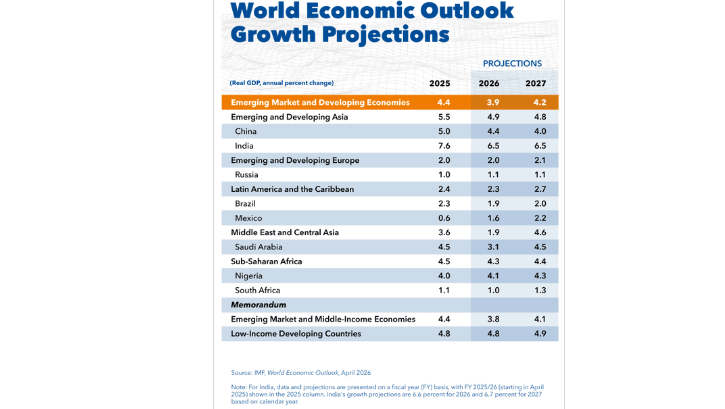
The impact on the global economies is already large, even if the conflict is short-lived. Extensive infrastructure damage and supply chain disruptions are pushing prices up and slowing global growth, down from 3.4 percent last year to 3.1 percent in 2026.
But if the conflict persists and oil prices stay high for an extended period, we must brace for tough times ahead.
Our World Economic Outlook outlines of range of scenarios: In the most adverse case growth could fall to two percent, and the shock is global. All countries are affected by higher energy prices. But the negative impact is highly asymmetric, with the biggest burdens falling on countries that import energy and have limited policy space.
In many cases, these are low income or fragile economies. They need attention, and an important focus of our discussion this week is on how we can best support them.
In this world of frequent shocks and uncertainty, what is our policy advice to our members? In the short-term maintaining microeconomic and financial stability is key. Understandably, governments would like to help businesses and people hit by the exogenous supply shock.
My advice? Look before you leap on monetary policy, for countries where monetary policy was well calibrated before the shock and expectations remain anchored – Wait and see is the right approach.
In other countries, early policy action may be required on fiscal policy. We have been warning for some time that public that is constraining fiscal space.
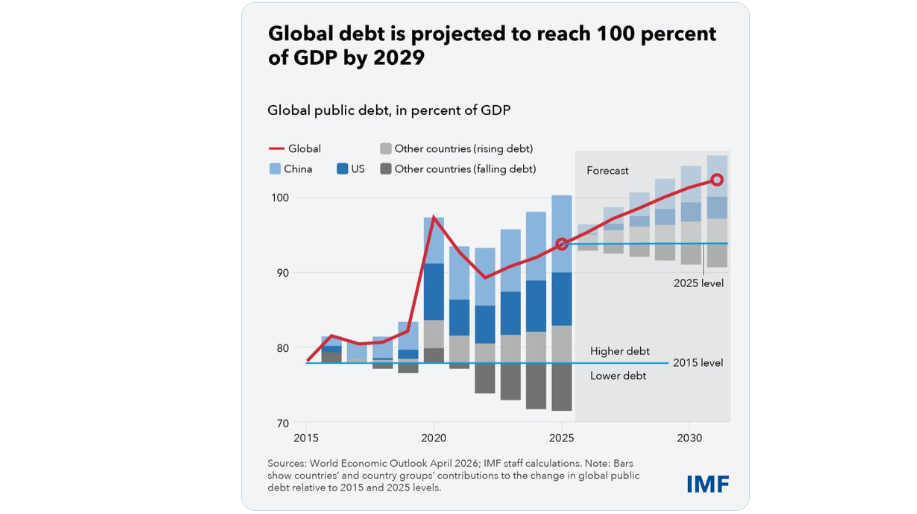
I want to stress what is different this time in comparison to Covid. This is the cumulative impact of shock upon shock. It has pushed that to dangerously high levels. Global public that is on track to breach 100 percent of GDP in 2029; A level not seen since the aftermath of World War II.
So, to maintain their fiscal policy credibility, policy makers need to strike a careful balance between safeguarding fiscal sustainability and protecting those who are hit the hardest and have least capacity to respond.
The good news is that many countries have so far avoided untargeted tax cuts, energy subsidies, and price controls.
The not so good news is that we are seeing some countries putting in place untargeted measures, export controls, or broad-based tax cuts.
While the intention behind these measures may be good, it is to protect people from the shock, such untargeted actions will only prolong the pain of high prices.
Finally, even as policy makers respond to the short-term effects of this shock, they must not lose sight, of broader forces affecting the global economy from geopolitics and trade to technology, demographics, and climate. We must adapt our policy to these long-term trends by accelerating growth-oriented reforms. Because these reforms will protect us from the shocks to come. Policy makers will need to carry out structuraal reforms to lift productivity and growth.
A strong economy is the best buffer. And once this shock passes, then we need to rebuild policy space.
Now, let me turn to the role of the IMF as our global policy agenda makes clear. We serve as the firefighter for our member countries, and we are committed to helping them navigate this complex landscape.
We anticipate new term demand for IMF financial support to range between 20 and 50 billion dollars. This represents augmentations of some existing problems. Currently, we have 39 programs and prospective demand for new programs from at least a dozen countries. A number of them in Sub-Saharan Africa.
We are coordinating closely with the World Bank, with the International Energy Agency, with other partners, including at regional level, to maximize our combined response. Even as we step up our support, we continue to adapt our tool kit: We are doing very important reviews, review of program design and conditionality, comprehensive surveillance review, review of our FSAP, so we can further sharpen the policy advice we provide to our members.
We continue to work on countries on that, including through the global sovereign debt round table. It will meet again this afternoon. And as our member countries navigate this moment of uncertainty, we are helping them think ahead so they can handle any form of turbulence.
We love our membership.
Thank you.
(Colombo/Apr15/2026)
Continue Reading




Leave a Reply