

Tuesday May 5, 2026 11:46 pm
Tuesday May 5, 2026 11:46 pm
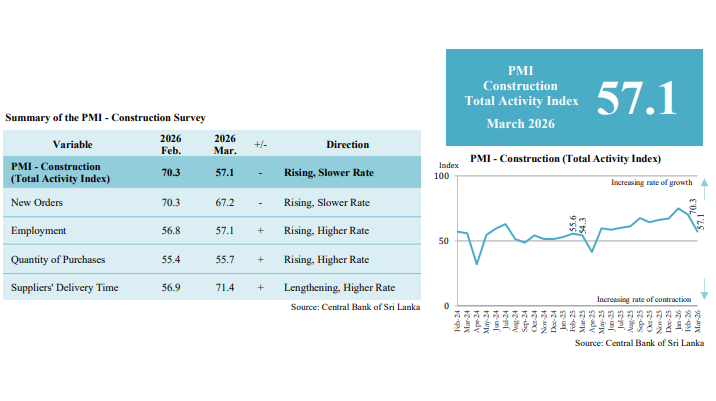
ECONOMYNEXT – Sri Lanka’s construction sector activity continued to expand in March 2026, registering an index value of 57.1, a much slower rate than the previous month’s 70.3, according to a Purchasing Managers Index compiled by the central bank.
“Many respondents reported a challenging operating environment, mainly due to limited availability of fuel and raw materials, rising costs, and logistical bottlenecks stemming from the conflict in the Middle East,” the central bank said.
The New Orders Index expanded in March, registering 67.2 from last month’s 70.3, with respondents saying project flows remained robust.
The Employment and Quantity of Purchases Indices increased further in March, indicating that firms continued with planned hiring and procurement despite prevailing uncertainties, CBSL said.
“Many respondents noted that amid expectations of further price increases, most firms sought to build up stocks, while suppliers tended to hold back on materials,” the central bank said.
The Quantity of Purchases Index expanded, registering 71.4 from last month’s 56.9, due to higher construction activities.
Suppliers’ Delivery Time lengthened notably reflecting transportation-related delays. (Colombo/May6/2026)
Wednesday May 6, 2026 8:42 am
Wednesday May 6, 2026 8:42 am
ECONOMYNEXT – Colombo Dockyard PLC reported a loss of 428.1 million rupees for the quarter ended March 31, 2026, narrowing from a loss of 634.4 million rupees in the corresponding period last year.
The quarter also finalized the transition of control to India’s state-owned Mazagon Dock Shipbuilders Limited (MDL), which now holds a 51% stake (201.57 million shares) in the company.
The company reported a loss per share of 1.32 rupees for the three-month period, compared to a loss of 2.75 rupees per share a year earlier.
Revenue for the quarter grew 7.6 percent to 7.61 billion rupees from 7.07 billion rupees in 2025. Cost of sales for the period rose to 6.59 billion rupees, resulting in a gross profit of 1.02 billion rupees.
However, the quarter’s performance was impacted by administrative expenses of 1.09 billion rupees and net finance expenses of 271.2 million rupees.
This quarter marked the end of an extended 15-month financial period (January 1, 2025, to March 31, 2026), following a decision to change the company’s financial year-end from December to March.
For the full 15-month period, the group reported a total loss attributable to owners of 2.91 billion rupees on a turnover of 36.20 billion rupees.
The reporting period was defined by a major restructuring of the company’s capital and ownership. Colombo Dockyard successfully completed a rights issue, raising 12.93 billion rupees in new equity.
This capital infusion strengthened the balance sheet, increasing the stated capital to 13.65 billion rupees as of March 31, 2026, compared to just 714.4 million rupees at the end of 2024.
Consequently, the group’s total equity rose to 15.50 billion rupees.
On a segmental basis for the full 15-month period, ship repairs remained the largest revenue driver at 17.53 billion rupees, while shipbuilding contributed 14.04 billion rupees.
While shipbuilding achieved a segment profit of 5.58 billion rupees at the gross profit level, the ship repair segment recorded a loss of 2.49 billion rupees for the same period. (Colombo/May06/2026)
Continue Reading
Tuesday May 5, 2026 6:30 pm
Tuesday May 5, 2026 6:30 pm
ECONOMYNEXT – Sri Lanka may face a shortage of medicines as the pharmaceutical industry is facing a challenge due to the regulator failing to allow price revisions despite the rupee fall and amid restrictive price caps, industry stakeholders say.
The Sri Lanka rupee has tumbled with the Central Bank’s indicative exchange rate falling 5.6% in the last six months – from 302.6 per US dollar in October 2025 to 319.5 this week.
Sri Lanka is heavily dependent on medicines imports.
The island nation imported US$ 667 million worth drugs last year, accounting for approximately 85% of the total medicinal drug market.
The industry regulator, National Medical Regulatory Authority (NMRA), allowed the last price revision in July 2023, industry stakeholders say.
“Because there is a huge exchange increase, the industry is due for a price increase,” Shantha Bandara, President of the Sri Lanka Chamber of the Pharmaceutical Industry (SLCPI), told EconomyNext.
“All the other products have gone up except medicine which went down significantly. If that doesn’t happen, we are unable to place orders.”
The NMRA guidelines state that if the exchange rate fluctuates by more than 5%, rise or fall, the Authority may review and revise maximum retail prices (MRPs) of drugs.
Follow the EconomyNext WhatsApp Channel
Get breaking updates, instant alerts, and exclusives.
Join Now
Bandara said the last revision, a 16% price cut, was done in July 2023 for selected drugs.
The SLCPI and Sri Lanka Pharmaceutical Manufacturers’ Association (SLPMA) raised concerns over delay in upward price revision, noting that the “market-blind” controls make it impossible to sustain operations.
Nalin Kannangara, the president SLPMA stated that the cost of medicines has risen by up to 25% due to exchange rate depreciation and regional instability in the Middle East.
“Now, because of this Middle East crisis, there can be a shortage of finish pharma in the market,” Kannangara told EconomyNext.
“Imports now have a lot of challenges because of the freight issues, insurance and exchange risks associated.”
Though there is a price formula in place, the exchange rate is the main component of that, stakeholders say.
Repeated attempts to contact NMRA for comments failed, as it did not respond to calls or emails.
Health Minister Nalinda Jayatissa, however, acknowledged the pressure due to the rupee depreciation.
“There is a 5% [provision]. If there is a slight increase in the dollar, a price increase must be granted,” Jayatissa told EconomyNext.
He said the government may allow an increase in the “ceiling price” for drug importers and not the retail price. (Colombo/May5/2026)
Continue Reading
Tuesday May 5, 2026 5:46 pm
Tuesday May 5, 2026 5:46 pm
ECONOMYNEXT- Sri Lanka’s rupee closed at 319.90/320.40 to the US dollar in the spot market on Tuesday, from 319.60/320.00 the previous day, dealers said, while bond yields edged up.
A bond maturing on 01.07.2028 closed at 9.75/85 percent.
A bond maturing on 15.10.2029 closed at 10.05/15 percent, up from 9.95/10.05 percent.
Follow the EconomyNext WhatsApp Channel
Get breaking updates, instant alerts, and exclusives.
Join Now
A bond maturing on 01.07.2030 closed flat at 10.20/25 percent.
A bond maturing on 01.06.2033 closed at 11.00/10 percent.
A bond maturing on 15.06.2034 closed at 11.25/30 percent, up from 11.20/25 percent.
A bond maturing on 15.06.2035 closed at 11.25/32 percent.
100,000 million rupees Treasury bills are to be issued through an auction on Wednesday. (Colombo/May5/2026)
Continue Reading
Tuesday May 5, 2026 4:05 pm
Tuesday May 5, 2026 4:05 pm
ECONOMYNEXT – Sri Lanka Customs exceeded its April target by 30.5%, while revenue in the first four months jumped around 50 percent compared to the same period last year, official data showed.
Customs’ April revenue target was set at 181.2 billion rupees. However, the revenue-collecting body collected 236.5 billion rupees in the month, exceeding the target by 30.5%, official data showed.
It also exceeded the cumulative target in the first four months by 33.7% to achieve 919.3 billion rupees.
Customs has been accelerating container clearance since January after the devastation in November impacted usual activities.
Total revenue collected by Customs jumped 49.8% in the first four months of this year compared to the same period last year.
Last year, Customs collected a record 2,551 billion rupees in revenue, exceeding a revised target of 2,241 billion rupees for the year and achieving 64.2% higher revenue than the previous year’s revenue of 1,553 million rupees.
Follow the EconomyNext WhatsApp Channel
Get breaking updates, instant alerts, and exclusives.
Join Now
Customs has set a revenue target of 2,207 billion rupees for this year, 13.5% less than last year as it expects a significant decline in car imports. Data showed it achieved 41.7% of this year’s target in the first four months.
Sri Lanka Customs’ revenue jump is largely due to stronger enforcement, improved valuation practices, and a rebound in import volumes after years of contraction.
Following the 2022 economic crisis, imports fell sharply as the country imposed restrictions to conserve foreign exchange.
However, with the stabilization of reserves, the relaxation of certain import controls, and a steady recovery in consumer demand, customs collections from import duties, excise, and other levies have risen.
Officials note that tighter monitoring of under-invoicing and misdeclaration of goods has also contributed to boosting state revenue.
The combined effect of increased import activity, currency movements, and stricter enforcement has positioned Customs as one of the top revenue sources for the Treasury in 2025, providing a vital cushion as the state works to meet fiscal targets under the IMF-supported program. (Colombo/May 05/2026)
Continue Reading
Tuesday May 5, 2026 3:50 pm
Tuesday May 5, 2026 3:50 pm
ECONOMYNEXT — Sri Lanka’s cabinet has approved the acquisition of land for the long-delayed development of the Kelani Valley (KV) railway line, from Maradana to Avissawella, minister Nalinda Jayatissa said.
The project, which aims to modernize the narrow-gauge corridor, will involve land acquisition across seven Divisional Secretariat Divisions, including Colombo, Thimbirigasyaya, Sri Jayewardenepura Kotte, Maharagama, Homagama, Padukka, and Seethawaka.
The project seeks to secure the necessary right-of-way for a track that has long suffered from speed restrictions and aging infrastructure.
The government is moving to finalize the preliminary phases of land acquisition, Cabinet Spokesperson Nalinda Jayatissa told reporters.
Follow the EconomyNext WhatsApp Channel
Get breaking updates, instant alerts, and exclusives.
Join Now
“At present, this is in the stage of identifying and acquiring lands; funds have been allocated for that purpose, and those activities have been expedited,” Jayatissa said.
The cabinet had previously granted in-principle approval for the development and the resettlement of families currently living within the railway’s lands. Financial provisions have already been earmarked to compensate and relocate those affected by the expansion. (Colombo/May5/2026)
Continue Reading
Tuesday May 5, 2026 3:45 pm
Tuesday May 5, 2026 3:45 pm
ECONOMYNEXT — Sri Lanka’s Ministry of Power and Energy is implementing technical reforms, including the procurement of specialized software and battery storage systems, to prevent a recurrence of the countrywide power outage experienced in February 2025, Energy Minister Anura Karunathilaka told Parliament.
Two committees — one from the ministry and another from the Ceylon Electricity Board (CEB) — appointed to investigate the failures of February 9, 2025, made 12 recommendations to secure the national grid against future instability, he said.
“We have instructed the Ceylon Electricity Board to implement the recommendations of the ministry committee immediately to ensure system stability,” Karunathilaka said.
The CEB is procuring “RE-desk” software for its System Control Center, he said, a tool designed to monitor and control the growing number of renewable energy plants connected to the grid.
Follow the EconomyNext WhatsApp Channel
Get breaking updates, instant alerts, and exclusives.
Join Now
A new software system for forecasting renewable energy production has already been purchased and is now operational, he said.
To address the physical stability of the system, the government has started setting up battery energy storage systems (BESS), he said, and steps are also being taken to install a synchronous condenser at the New Habarana Grid Substation with funding from the World Bank.
Karunathilaka said the ministry is paying attention to periods of low electricity demand, such as Sundays and public holidays, which can pose risks to grid balance. A special operational policy is now in place to increase the “inertia” of traditional generation systems during these times to keep the frequency stable.
The CEB has also been instructed to update and publish protection parameters and re-evaluate load-shedding settings to better reflect the current energy mix. A four-member monitoring committee has been appointed to oversee the progress of these various interventions. (Colombo/May5/2026)
Continue Reading










Leave a Reply