


Thursday February 5, 2026 4:20 pm
Thursday February 5, 2026 4:20 pm
ECONOMYNEXT – Sri Lanka’s Cinnamon Life City of Dreams, with the John Keells Foundation and Nations Trust Bank, is hosting the West-End licensed musical La Bamba! The Song of Veraruz in an effort to promote Colombo as an entertainment hub in South Asia.
“If Colombo can add soft value to the city such as events, museums, art galleries…, it can be one of the leading destinations in South Asia,” Dileep Mudadeniya, Global Alliances & Partnerships & Head of Corporate Affairs, John Keells Holdings PLC told reporters at an event to announce the production.
This will be the first production of its scale that will be hosted in-house at Cinnamon Life City of Dreams, the organizers said.
The production will be overseen by veterans of local theatre, Jerome de Silva, as associate director, and Soundarie David, as associate music director, in collaboration with the British Council of Sri Lanka.
“We’ll be calling for auditions, selecting local cast for certain roles as well,” David said.
The production aims to maintain its international reputation that has received much acclaim, while adding a cultural twist, organizers said, and will therefore have a healthy mix of actors with exposure to international performances, as well as local talent.
“The DNA of the West End or Broadway productions exist with us because of the talent we have in this country,” de Silva said.
With La Bamba! The Song of Veraruz, they hope it sets the standard for further productions in the future, he said.
The show will play at Cinnamon Life City of Dreams from April 24-28, with 7 showings planned within the 5 days.
Tickets are now available for La Bamba! The Song of Veraruz, with Nations Trust Bank offering a 10 percent discount to its American Express card members. (Colombo/Feb5/2026)
Thursday February 5, 2026 5:54 pm
Thursday February 5, 2026 5:54 pm
ECONOMYNEXT – Sri Lanka’s rupee closed at 309.45/50 to the US dollar in the spot market Thursday, unchanged from 309.45/55 the previous day, while bond yields dropped significantly from the mid- to long end of the yield curve, dealers said.
A bond maturing on 15.12.2026 closed flat at 8.25/30 percent.
A bond maturing on 15.09.2027 closed at 8.60/70 percent, down from 8.65/70 percent.
A bond maturing on 15.02.2028 closed at 8.97/9.02 percent.
A bond maturing on 01.05.2028 closed at 9.08/12 percent.
A bond maturing on 15.12.2029 closed at 9.55/60 percent, down from 9.58/62 percent.
A bond maturing on 01.03.2030 closed at 9.65/69 percent, down from 9.69/72 percent.
A bond maturing on 15.03.2031 closed at 9.88/90 percent, down from 9.90/94 percent.
A bond maturing on 01.10.2032 closed at 10.23/25 percent, down from 10.25/30 percent.
A bond maturing on 01.06.2033 closed at 10.57/60 percent.
A bond maturing on 15.06.2035 closed at 10.82/87 percent, down from 10.85/90 percent. (Colombo/Feb5/2026)
Continue Reading
Thursday February 5, 2026 3:00 pm
Thursday February 5, 2026 3:00 pm
ECONOMYNEXT – Sri Lanka’s Institute of Policy Studies is calling proposals from university students for the annual Saman Kelegama research grant.
“This annual grant creates an exciting opportunity for a select undergraduate, supporting them in their research with both financial aid and mentorship,” IPS said.
The grant is open to undergraduate students currently in their fourth year or about to enter their fourth year in 2026, studying economics or a related subject.
The recipient will receive a one-time research grant of 200,000 rupees.
The full statement is reproduced below:
Call for Applications: Saman Kelegama Memorial Research Grant 2026
The Institute of Policy Studies of Sri Lanka (IPS) calls for applications for the Saman Kelegama Memorial Research Grant 2026, established in 2018 in memory of Dr. Saman Kelegama, former Executive Director of IPS, to support policy relevant socioeconomic research by undergraduate students.
The Grant is a merit based annual award open to undergraduate students currently in their fourth year or about to enter their fourth year in 2026, studying economics or a related subject at a University Grants Commission approved university or higher education institution in Sri Lanka.
It aims to promote original, rigorous, and innovative research with clear policy relevance. Proposed studies must be independent of final year projects or other ongoing research.
The selected recipient will receive a onetime research grant of LKR 200,000, together with a three month internship at IPS, with access to senior researchers and institutional resources.
Flexible internship arrangements are available to accommodate students from across the country.
Additional support will be provided to present research findings at local conferences and workshops.
Proposals will be assessed based on policy relevance, feasibility, originality, and creativity.
Three shortlisted candidates will be invited to present at IPS, following which the Grant recipient will be selected.
The recipient will be required to produce a Policy Discussion Brief within six months of receiving the Grant.
Key Dates:
– 31 March 2026: Proposal submission deadline
– 31 May 2026: Announcement of finalists
– 23 June 2026: Announcement of Grant recipient
Applications must be submitted in English, in Word format, in accordance with the prescribed guidelines, and emailed to tharakam@ips.lk.
By supporting young researchers and promoting evidencebased inquiry, the IPS’ Saman Kelegama Memorial Research Grant continues Dr. Kelegama’s vision of strengthening policy discourse and advancing inclusive development in Sri Lanka.
For further information, visit www.ips.lk. (Colombo/Feb5/2026)
Continue Reading
Thursday February 5, 2026 10:30 am
Thursday February 5, 2026 10:30 am
ECONOMYNEXT – Canada-based Fairfax financial group has increased its stake in Sri Lanka’s John Keells Holdings, with another foreign investor selling out, market sources said.
Fairfax, through HWIC Asia Fund, already had a 25.5 percent stake in JKH and is the largest shareholder.
Norges Fund 2, Norway’s sovereign wealth fund, had a 1.1 percent stake in JKH (188 million shares), has sold shares, market sources said. (Colombo/Feb5/2026)
Continue Reading
Thursday February 5, 2026 9:30 am
Thursday February 5, 2026 9:30 am
ECONOMYNEXT – Sri Lanka’s rupee was quoted at 309.45/50 to the US dollar in the spot market Thursday, relatively unchanged from 309.45/55 Tuesday, while bond yields edged lower on longer tenors, dealers said.
A bond maturing on 15.09.2027 was quoted at 8.67/70 percent, up from 8.65/70 percent.
A bond maturing on 15.02.2028 was quoted at 8.98.9/05 percent.
A bond maturing on 15.09.2029 was quoted at 9.55/60 percent.
A bond maturing on 15.12.2029 was quoted at 9.60/65 percent, up from 9.58/62 percent.
A bond maturing on 01.03.2030 was quoted at 9.67/73 percent, from 9.69/72 percent.
A bond maturing on 15.03.2031 was quoted flat at 9.90/94 percent.
A bond maturing on 01.10.2032 was quoted flat at 10.25/30 percent.
A bond maturing on 01.06.2033 was quoted at 10.60/63 percent.
A bond maturing on 15.06.2034 was quoted flat at 10.82/84 percent.
A bond maturing on 15.06.2035 was quoted at 10.87/90 percent, up from 10.85/90 percent. (Colombo/Feb5/2026)
Continue Reading
Wednesday February 4, 2026 7:37 pm
Wednesday February 4, 2026 7:37 pm
ECONOMYNEXT – Sri Lanka should increase its trade with India with an aim to reduce risks in the ongoing geopolitical battle, a former Asian Development Bank research expert said.
Sri Lanka and India have a long history of attempting to upgrade their 1998 Free Trade Agreement (FTA) into a broader “comprehensive” deal.
While technical negotiations were completed for two major frameworks, CEPA and ETCA, neither was signed due to intense political opposition and domestic pressure within Sri Lanka.
Ganeshan Wignaraja, a former director of research at Asian Development Bank Institute said upgrading existing FTA with India is seen as a key.
“So, the short answer for Sri Lanka I think is that you know there is this risk of trade diversion,” Wignaraja said at forum held in Colombo last week.
Sri Lanka’s merchandise exports to India were 1.04 billion US dollars in 2025 and Items under Indo-Lanka FTA had generated more exports than imports consistently, data show.
Wignaraja stressed on the need for Sri Lanka to integrate more with India’s market and reap the benefits of the Indian market and called for making it a more strategic relationship compared to what exists today.
“We have to really take a strategic view of India. We have a very limited trade agreement signed; you know decades ago. But there was a discussion on an investment agreement to build in the bits. I think we better do all that rather quickly,” he said.
CEPA (Comprehensive Economic Partnership Agreement) was negotiated between 2005 and 2008 with an aim to be the natural evolution of the existing FTA, moving beyond just “goods” to include services, investments, and technology transfer.
However, professional bodies of doctors, engineers, and lawyers along with local business chambers feared that Sri Lanka’s small market would be “swamped” by Indian professionals and cheaper labor, leading to mass local unemployment.
In 2008, the Mahinda Rajapaksa government faced heavy criticism from nationalist political allies who viewed the deal as a threat to national sovereignty.
Wignaraja pointed out that even under the existing Free Trade agreement there were many constraints that prevented greater trade from happening and a lot of opportunities still remained where further liberalization was possible.
“What is it that we can do in India given the way in which that earlier trade agreement was done? Lots of exclusions such as the quota on garments, there are lots of regulations that affect our primary agriculture stuff that can go to India,” he said.
“I think it really means stuff in services where there is less regulation right. It means for instance in Gift City there are opportunities for our companies to participate in ventures with them
“Also, it means I think trying to talk with Indians much more, and getting Sri Lankan labor to work in Mumbai and in important centers in India, otherwise we risk trade diversion which is what the model shows,” Wignaraja said. (Colombo/February 02/2026)
Continue Reading
Wednesday February 4, 2026 4:45 pm
Wednesday February 4, 2026 4:45 pm
ECONOMYNEXT – Sri Lanka’s central bank could have intervened to bring down short term rates that were moving up, but rates fell before the agency intervened, Central Bank Governor Nandalal Weerasinghe said.
Sri Lanka’s interbank rates moved up above 7.75 percent overnight policy rate (OPR) as private credit picked up last year until cyclone Ditwah, and also government relief payments in December.
Rates started to move down in January with the central bank also buying more dollars and injecting more liquidity.
“Banks which were running short liquidity are now having sufficient liquidity, as a result rates are coming back to a normal level of OPR.,” Governor Weerasinghe told reporters after holding the policy rate at 7.75 percent.
“That is, I think, a positive sign.
“Because in continuous movement in one direction there was some interventions we could have done.
“But we did not need to intervene in the short term interest rate market which has come down to OPR, normal levels.”
The rates are transmitting gradually to other benchmark rates such as Treasury bills and prime lending rates, he said.
Over 2025, the central bank allowed short term rates to move up, operating a scarce reserve regime, giving liquidity to banks at 8.25 percent, allowing price signals to work and encouraging banks to raise deposits instead of trading with central bank credit.
There is strong public opposition in Sri Lanka to monetizing deficits or banks balance sheets as such practices had led to currency crises and social unrest in the past.
Analysts had pointed out that rates automatically in a reserve collecting central bank with a scarce reserve regime, if there was a slowdown in credit from cyclone Ditwah and there was no need to cut rates.
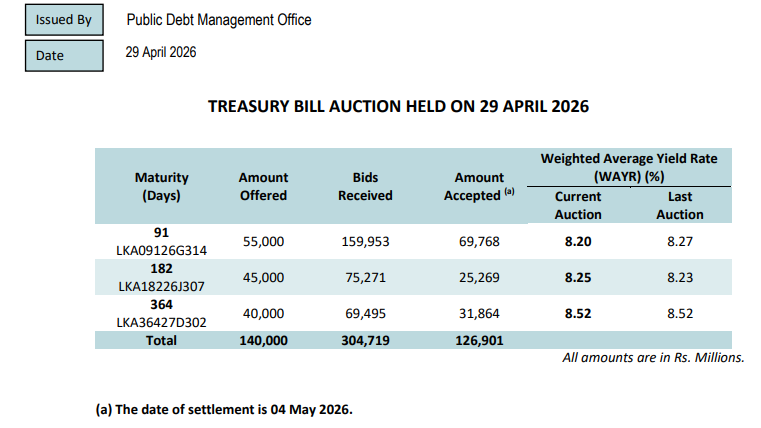
The Public Debt Management Office also allowed Treasury bill rates to go up, which would also crowd out private credit, (or curb consumption and encourage savings), reducing risks of a currency crisis and a second default, unlike in the past.
RELATED : Sri Lanka Treasury bill yields edge up, breaking ramrod rate anomaly
Related : Sri Lanka’s private sector credit slows in December: CB official
A slowdown in credit widens a balance of payments surplus, which allows the central bank to buy more dollars (monetize a balance of payments surplus in the words of a former central bank governor) or allow the currency to appreciate or both.
Natural disasters have tended to slow private credit in the past such as during the tsunami in 2004.
There was also a slowdown in private credit in January 2025 after a spike in later 2024. (Colombo/Jan03/2026)
Continue Reading








Leave a Reply